10 Simple Mindfulness Drawing Exercises for Daily Calm
Ten gentle drawing practices to quiet a busy mind, release stress, and build a daily creative ritual — no skill required, just ten minutes and a willingness to show up.
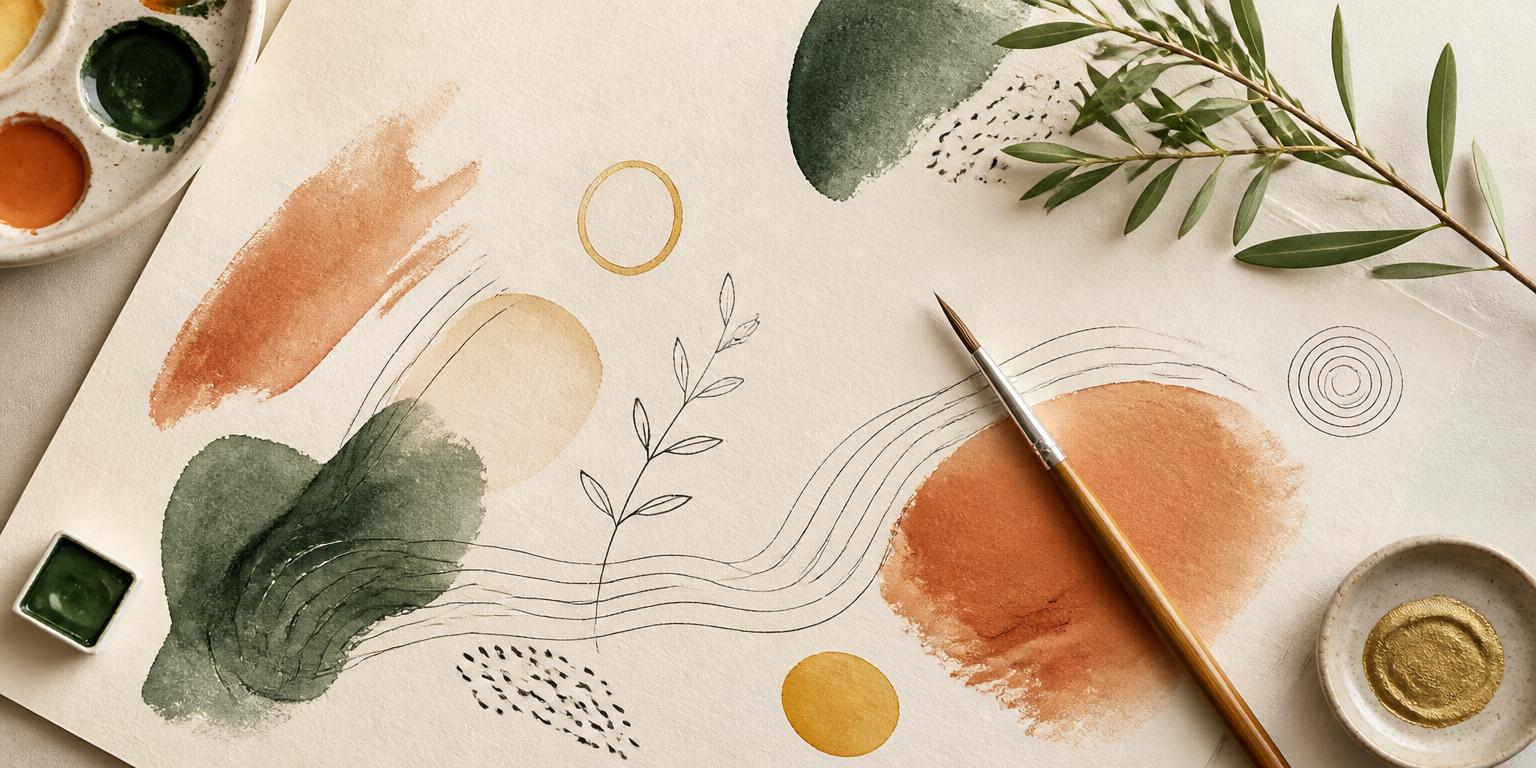
Your mind is loud. The to-do list, the half-finished conversation, the thing you should have said. Mindfulness drawing is a way to set all of that down — not by emptying your head, but by giving your hands something gentle to do while your attention settles.
You don't need to be an artist. You don't need expensive supplies. A pen and a scrap of paper will do. What you need is ten minutes and the willingness to make something that doesn't have to be good. That permission — to be a beginner, to be imperfect, to simply notice — is where the calm lives.
What is mindfulness drawing?
Mindfulness drawing — sometimes called meditative art — is the practice of drawing with your full attention on the present moment. Instead of focusing on the result, you focus on the process: the feel of the pen, the movement of your hand, the sound of the line on the paper.
It sits at the intersection of two traditions. Mindfulness teaches you to notice without judging. Drawing gives your hands a focus so your mind can settle. Together, they create a state that researchers call flow — that quietly absorbed feeling where time seems to soften and the background noise dims.
The exercises below are not art lessons. There are no techniques to master, no perspective to get right, no proportions to nail. Each one is a small doorway into presence. Try them in order, or skip to the one that calls to you. The only rule is the one the Be Artistic Club manifesto already holds: you don't need to be talented. You need to show up.
Ten mindfulness drawing exercises to try today
Each takes five to ten minutes. You'll need a pen or pencil and a few sheets of plain paper. Watercolours are welcome but never required.
- 1
The Breath Line
The simplest mindfulness drawing exercise there is — a single line that mirrors your breathing.
How to do it
- 1.Place your pen on the page and close your eyes.
- 2.As you inhale, let your hand drift slowly upward.
- 3.As you exhale, let it drift gently back down.
- 4.Continue for ten breaths. Don't open your eyes. Don't judge the line.
Why it works
It anchors your attention to your breath — the foundation of every mindfulness practice. The line becomes a visual record of your breathing, and there is no wrong way to draw it.
A gentle tip
If your mind wanders (it will), simply notice and return to the next inhale. That noticing is the whole practice.
- 2
Blind Contour Drawing
Draw an object while looking only at it — never at your page.
How to do it
- 1.Pick something simple: a mug, a plant, your own hand.
- 2.Place your pen on the page and fix your eyes on the object.
- 3.Slowly trace every edge you see, moving your pen at the same pace.
- 4.Don't lift your pen. Don't look down. Continue for two to three minutes.
Why it works
Blind contour forces you into the present moment. You can't plan or correct because you can't see the result, so the inner critic has nothing to grip. The drawings are always strange and always alive.
A gentle tip
The messier the result, the more you were actually looking. A tidy blind contour usually means you peeked.
- 3
Found-Object Mark-Making
Make marks with anything except a brush — a twig, a piece of cardboard, a leaf, the edge of a credit card.
How to do it
- 1.Gather three or four objects from your desk, kitchen, or garden.
- 2.Dip each in ink or watercolour and drag, press, stamp, or flick it across the page.
- 3.Let each object reveal its own character — the scratch of a twig, the soft press of a leaf.
- 4.Fill the page without trying to make a picture.
Why it works
Mark-making sidesteps the pressure to draw something recognisable. It is pure process — sensation, texture, rhythm. It is also Day 3 of the Be Artistic Club journey, where the invitation is to fill a page with marks made by something that isn't a brush.
A gentle tip
Notice how each tool feels different in your hand. That noticing — not the marks themselves — is the mindfulness.
- 4
Slow Contour Study
Draw the outline of an object at an agonisingly slow pace — one millimetre at a time.
How to do it
- 1.Choose an object with an interesting edge — a key, a shell, a crumpled leaf.
- 2.Move your pen so slowly it feels almost still.
- 3.Match your pen speed to your breathing — one small movement per breath.
- 4.Continue for five minutes on a single outline.
Why it works
Slowness is the antidote to a racing mind. When you move this slowly, you notice details you'd normally skip — a ridge, a chip, a curve you'd never seen. The drawing becomes an act of attention rather than production.
A gentle tip
If you feel impatient, that's information, not failure. Stay with it for one more breath.
- 5
Mandala of the Moment
Build a circular, radially symmetric pattern from the centre outward — one repeated element at a time.
How to do it
- 1.Draw a small circle in the centre of your page.
- 2.Add one simple shape around it — a petal, a dot, a leaf.
- 3.Repeat that shape all the way around the circle.
- 4.Add a new ring with a new shape. Repeat. Continue outward as far as you like.
Why it works
The repetition is meditative — it gives the mind a gentle, predictable rhythm to rest in. Mandalas have been used for centuries as a focus for meditation because the structure holds you while you fill it in.
A gentle tip
Don't aim for perfection. Slight asymmetry is what makes a hand-drawn mandala feel human rather than printed.
- 6
Repetitive Pattern Zoning
Divide a page into simple zones and fill each with a different repeating pattern — dots, waves, crosses, spirals.
How to do it
- 1.Lightly draw a grid or a few organic shapes on your page.
- 2.Choose one simple pattern per zone.
- 3.Fill each zone slowly and completely, repeating the same mark.
- 4.Let the patterns meet and overlap at the boundaries.
Why it works
This is the principle behind Zentangle — structured repetition that induces a calm, flow-like state. The limited choices (one pattern per zone) reduce overwhelm, and the repetition itself becomes soothing.
A gentle tip
Let your hand find a rhythm. Once it does, your thinking mind tends to quiet on its own.
- 7
Non-Dominant Hand Drawing
Draw with the hand you don't usually use.
How to do it
- 1.Switch your pen to your non-dominant hand.
- 2.Draw a simple object — a cup, a flower, a face.
- 3.Don't try to control the outcome. Let the lines be wobbly.
- 4.Spend three to five minutes before switching back.
Why it works
Your non-dominant hand is less practised, so it can't produce the polished drawing your inner critic demands. That failure is the gift — it frees you from the goal of making something impressive and returns you to the simple act of looking and moving.
A gentle tip
The awkwardness is the point. Smile at it. You're not making art for a gallery; you're coming home to yourself.
- 8
Emotional Colour Wash
Paint a colour wash that represents how you feel right now — not how you think you should feel.
How to do it
- 1.Pause and check in with yourself. What colour is this moment?
- 2.Mix that colour in watercolour, or choose a pencil or pastel in that tone.
- 3.Cover the page with it — washes, blocks, sweeping strokes.
- 4.Add a second colour if a different feeling surfaces partway through.
Why it works
Naming a feeling as a colour gives it somewhere to go without needing words. It's a way of acknowledging what's present without analysing it — the core of mindful awareness.
A gentle tip
You don't have to understand the feeling to paint it. The colour is enough.
- 9
One Continuous Line
Draw an entire subject without lifting your pen from the page.
How to do it
- 1.Pick a subject — your desk, a window view, a plant.
- 2.Place your pen down and begin drawing.
- 3.Don't lift. When you need to move to a new area, trace a line through the page to get there.
- 4.Keep going until the subject feels complete enough.
Why it works
The single-line constraint keeps you in continuous contact with the page. There's no stopping to assess, erase, or restart — just an unbroken conversation between eye and hand. It's drawing as one sustained breath.
A gentle tip
Let the line double back on itself. The crossings and tangles are where the drawing gets interesting.
- 10
Gratitude Sketch
Draw something you're grateful for today — however small, however imperfectly.
How to do it
- 1.Think of one thing that brought you a moment of ease — a warm cup, sunlight on a wall, a text from a friend.
- 2.Draw it. Not well. Just honestly.
- 3.Write one sentence beside it about why it mattered.
- 4.Leave it. Let the page hold it for you.
Why it works
Gratitude sketching pairs mindfulness with appreciation — two practices that, together, reliably lower stress. The drawing doesn't need to be good; it needs to be noticed. You're training your attention to land on what's nourishing.
A gentle tip
Do this one last, as a gentle close to your drawing session. It turns the page into a small record of something good.
How to turn mindfulness drawing into a daily habit
A single session will lower your stress for an afternoon. A daily practice will change your relationship with your own mind. The gap between the two is not talent — it's consistency. Here's how to build it without burning out.
Start with ten minutes
Not an hour. Not a masterpiece. Ten minutes is enough to feel different and small enough to actually do tomorrow.
Pick one exercise, not ten
Choose a single practice for the week. Repetition builds the neural pathway; variety at the start just builds resistance.
Same time, same place
Anchor your practice to something you already do — after the morning coffee, before bed. The cue does the remembering for you.
Check in before and after
Notice your mood when you sit down and when you finish. The shift is your evidence that it's working — and it's rarely what you expect.
Let it be imperfect
Some days the drawing will be loose and alive. Other days it'll feel flat. Both count. Showing up is the practice; the drawing is the byproduct.
Keep a single sketchbook. Not five. One. Let it accumulate. After a month, flip back to the first page and notice what's changed — not in the drawings, but in how you felt making them. That quiet record is the real reward.
Your daily practice, held for you
Begin your 365-day journey into mindful creativity
Be Artistic Club sends you one gentle invitation every day — a prompt, a mood check-in, and ten minutes of painting. No grades. No comparison. Just you, returning to yourself, one calm moment at a time. The first week is free to taste, starting with mark-making, stillness, and the permission to make something on purpose-bad.
"Coming home to myself for ten minutes today."